This music lesson is brought to you from:
www.ArchEnemys.com Online Social Network Magazine
ArchEnemys
Inc, is a multimedia production company founded in 1997 by Nate
LaChance. In 2004, Nate met Carrie LaChance, a hostess at a
local restaurant. After a few months of working together the
two quickly teamed up and began to build ArchEnemys into a thriving
business.

ArchEnemys
The world of Burlesque Pin-Up
Nate & Carrie LaChance
Retail Store/Office
ArchEnemys
Suite 302
Portland, Maine 04101
Contact Us
Nate LaChance: President/CEO
Carrie LaChance: Vice President
Phone: (207) 430-8375
Email Nate: nate@archenemys.com
Email Carrie: carrie@archenemys.com
Guitar: Lesson 15
Basic Triadic Arpeggios
By Zack Cart
Prerequisites:
You
should be able to understand and perform the concepts and techniques outlined
in the following lessons before attempting this lesson:
Guitar: Lessons 1-14
Music Theory: Lessons 1-11
--------------------------------------------------------------------------------------------------
In
the past lesson we began to look at arpeggios, or "broken chords." In
this lesson we will look a little more closely at this element of Western
music.
--------------------------------------------------------------------------------------------------
"Arpeggio"
refers to any series of notes, initiated distinctly and singly, one after
another, which, if played simultaneously would be clearly identifiable as a
conventional chord, or which corresponds to the underlying chordal harmony at
the moment.
While
in the last lesson, we took a very loose, personal approach to arpeggios;
merely using chord shapes already in our chordal vocabulary to create
arpeggios, in this lesson we will use a much more structured system.
--------------------------------------------------------------------------------------------------
Let’s
begin, somewhat arbitrarily, with some D major arpeggios. This should be
relatively simple to understand, but likely more difficult to perform
physically, and certainly an investment of time in study and practice.
The
idea here, is to play all the notes of the chord in order, whether from the top
or the bottom, without excluding any, as may frequently have happened with the
previous lesson. For example, in a D major chord or arpeggio, we have the notes
D, F#, and A. In order to perform this style of arpeggio with D major, we will
play them one at a time, moving from one chord tone to the next. The resulting
pattern could be any number of things, but will always move from one tone to
the next in a given direction.
For
example, D, F#, A, D, ascending would fit the description, as would A, F#, D,
descending, or F#, A, D, F#, A ascending.
Many
players will learn a huge variety of arpeggio shapes and patterns, and then
implement these shapes as needed. I prefer a different approach, in which a far
smaller number of arpeggio shapes are learned, and are then practiced in a
manner similar to that used with scales. The patterns in this approach actually
encompass all of the many patterns involved in the first approach. Below are
some fretboard diagrams to help illustrate the point.
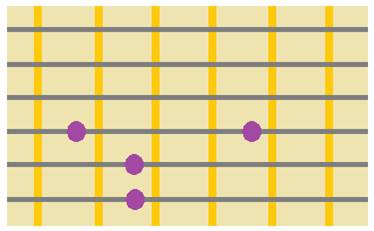
This is one example of a possible major triad
arpeggio, from the fifth of the chord up to the repetition of the fifth.
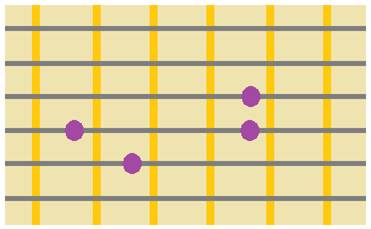
Here we have a major arpeggio from the root to the
root.
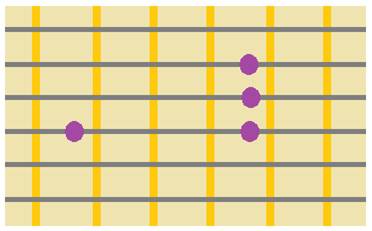
And another from the major third to the major third...
And finally another arpeggio from the Fifth to the
Fifth 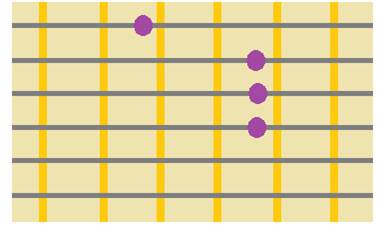
These
are all viable arpeggios, and are certainly useful to know and learn. However,
take a few minutes and carefully study the above four shapes, and then compare
them with the bottom shape. You will find that all of the previous shapes are
actually nothing more than a part of the final shape, shown below, with
outlines a major chord, ranging from the fifth on the Low E string, up through
the root, third, fifth again, root again, third again, and yet another fifth.
If
this shape is learned in it’s entirety, and practiced in as much detail as a
scale may be, not only is a deeper fretboard knowledge gained, as well as a
more intuitive and unlimited style of play, but the endless learning of smaller
arpeggio shapes becomes both redundant and unnecessary.
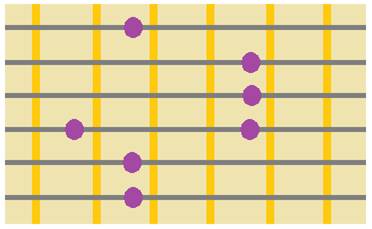
If
we learn this arpeggio with the notes performed between the fourth and seventh
frets, it will be a D major. The lowest note should be the fifth, or A. If we
move the pattern up a fret, it becomes Eb. Another fret up and it forms an E
major arpeggio, and so on.
So
learn this pattern, and then, staying in the general range of the fourth,
fifth, sixth, seventh, and eight frets, try to create arpeggio patterns which
will represent A Major, C Major, E Major, and G Major. These patterns should
include all chord tones available within those frets, and should span over all
six strings.
If you successfully create all five arpeggio shapes listed above, you will have created EVERY major triad arpeggio which is comfortably possible on the fretboard!