This music lesson is brought to you by :

http://www.augusta-seafood.com
Augusta Seafood
Seafood Market
Address: 2002 N Belfast Ave, Augusta, ME 04330
Phone: (207) 622-6951
MONDAY - SATURDAY 7 AM TO 5:30 PM & SUNDAY 8:00 AM TO 5:30 PM
Fathers Day Hours
8:00 am to 5:30 pm
Memorial Day Hours
7:00 am to 5:30 pm
Music Theory: Lesson 3
All Twelve Pitches: Modifying the Natural Notes
By Zack Cart
If you have not read, or are not comfortable with the information and exercises presented in the first two Music Theory lessons in this series, get comfortable! Otherwise, this lesson will be at best gibberish, or at worst, something which almost makes sense, you'll learn it wrong, and teach others the same incorrect system, creating a lineage of musicians who do not understand the system they are trying to learn, and cannot satisfactorily communicate with the larger music tradition!
We are now familiar with the seven white keys of the piano, or "natural" notes. However, looking at the keyboard, we see that there are five more pitches, don't we? They have names as well, but the names are derived from the seven natural notes. In addition to "natural" which designates those notes representing the white keys, we have several different pitch-modifiers, or "accidentals." The two most basic of these are called "sharps" and "flats." A "sharp" note designated by this symbol, "#" and means that the note to be played is the one which is a single pitch higher. To find this note, simply look at the keyboard, and play the key directly to the right of the natural note, counting black keys and white keys indifferently. A "flat" note designated by this symbol, "b" does the opposite; it means the pitch below the natural note, or one key to the left. The sharp and flat note names are shown on the keyboard below.
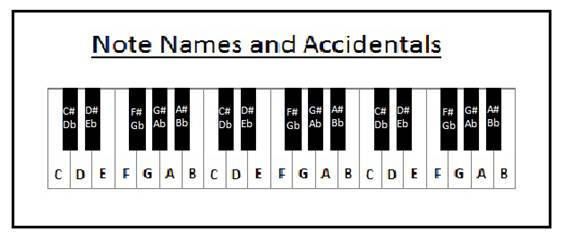
As be apparent by studying the keyboard, these modified notes fit in to the pattern of the seven natural notes, filling in the gaps, and completing the cycle of twelve pitches into which Western music traditionally divides the octave. You will notice that each of the black keys is given two names. This reflects the historical nature of theory, and underlines its impracticality. However, its what we're stuck with, so get used to it! For example, a sharp added to a C creates C# (C sharp). This should be one key to the right of the natural C note, as we see in the diagram. A flat added to a D creates Db, which is one key to the left of the natural D. Thus, two names for a single note.
Also, you will note that certain natural pitches (C, E, F, and B) lack either a sharp or flat. They do, in fact have them, but E# would really be F, Fb an E, B# is a C, and Cb a B. These will be necessary to learn later, but for now, ignore them, and only label black keys with accidentals.
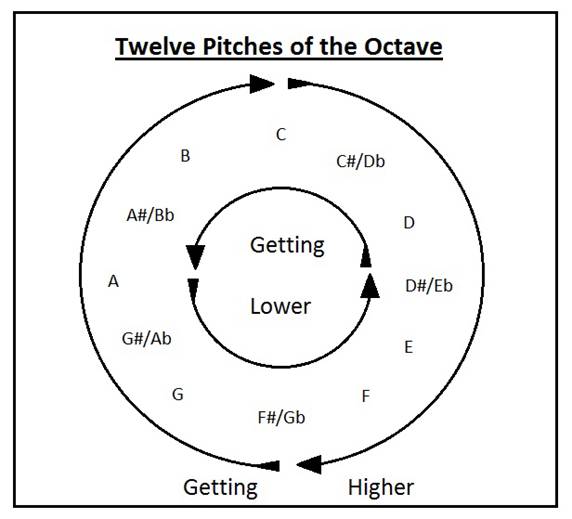
Below, you will see an image detailing the ascending and descending cycle of all twelve pitches.
We have discussed the symbols for
flat (b) and sharp (#) notes, but there is another commonly used modifier.
While assume a note without either a sharp or flat to be natural, it is
sometimes necessary to clarify this point, and so we have a symbol which means
"natural"  . Seeing this symbol merely means to play the
note natural. For our current purposes, it is just longhand version of the
notation covered in Music Theory: Lesson 2 - Notation of the Seven Basic
Pitches. Below are three staves (plural of "staff") Which show
the notational use of sharps, flats, and naturals, in varying clefs. Note, that
when describing a modified note in text, the note name precedes the accidental,
whereas in music notation, the accidental precedes the note name.
. Seeing this symbol merely means to play the
note natural. For our current purposes, it is just longhand version of the
notation covered in Music Theory: Lesson 2 - Notation of the Seven Basic
Pitches. Below are three staves (plural of "staff") Which show
the notational use of sharps, flats, and naturals, in varying clefs. Note, that
when describing a modified note in text, the note name precedes the accidental,
whereas in music notation, the accidental precedes the note name.



At this point you should repeat
the exercises detailed in Music Theory: Lesson 2 -
Notation of the Seven Basic Pitches, this
time with hefty doses of notes modified by sharps, flats, as well as natural
notes, both with and without natural symbols. Again, practice writing and then
playing, playing and then writing, all the while listening to the notes, and
keeping their names in your head. Having completely assimilated the information
from these three lessons, you will be able to go on to learn the basic
theoretical constructions of Western Music Theory.
Thus far, you have been learning the alphabet, soon, you will learn spelling, words, grammar, and speech. But for now, be patient and diligent!