
Music Theory: Lesson 7
Voicings and Inversions of Triads
By Zack Cart
Prerequisites:
You should be able to understand and perform the concepts and techniques outlined in the following lessons before attempting this lesson:
Music Theory: Lessons 1-6
--------------------------------------------------------------------------------------------------
In the previous Music Theory lesson, we explored the creations of ssimple triads, and found that. by taking a root note, and adding pitches at either a major or minor third above the root, and either a diminished, perfect, or augmented fifth above the root, we could create four distinctly different chords; Major, minor, augmented, and diminished.
In this lesson, we will further explore these chords, and learn the different ways in which the notes may be arranged in order to create harmonies other than the basic triad sound of the previous lesson.
Before, we had stacked all the notes in the order in which we had added them, Root on the bottom, then the Third, then the Fifth on top. In this lesson, we will look at some other possible arrangements of these notes.
--------------------------------------------------------------------------------------------------
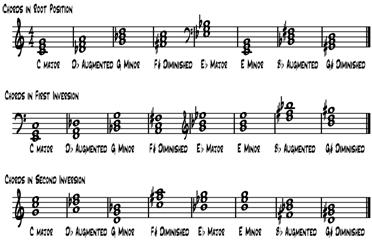
When the three notes of the triad are stacked with the Root on the bottom, or "in the bass", they are considered to be "in Root Position." Root position chords sound very stable, and are the simplest on the ear, although between the four triad types, there is a great deal of difference in stability and simplicity. Major and minor triads are quite stable and simple, while diminished and augmented chords are complex and tense.
When the three notes of a triad are placed such that the third is in the bass, (as the lowest note), the chord is said to be in "first inversion." Chords in first inversion are slightly less stable than root position triads, but are also a bit more flavorful.
Finally, we have second inversion. Second Inversion occurs when the fifth of the chord is in the bass. These triads sound unresolved, forward moving, and unstable, although as with first inversion, they lend more character to the triad then does root position.
Below are some examples of various chords in Root Position, First, and Second Inversion.
In addition to merely inverting the three notes, we can also duplicate notes in different octaves however we please. We can also spread the notes apart to farther octaves.
The naming system for the chord does not much change; the only note important for naming is that which is in the bass. In later lessons, we will cover the difference between "Open" and "Closed" position, which is relevant to the spread of the notes, but for now, we will play with these different ways to arrange or "voice" a chord in a less formal way.
Below are some examples of chords in Root Position and first and Second inversion, which have duplicated or doubled notes, as well as some notes which have been displaced to other octaves. The chords are presented on a "grand stave," which is actually two staves, on in the bass clef, and one in the treble, which are read together. Thus, the chord presented in the first meassure of the grand stave reads, from lowest to highest, C, G, E.
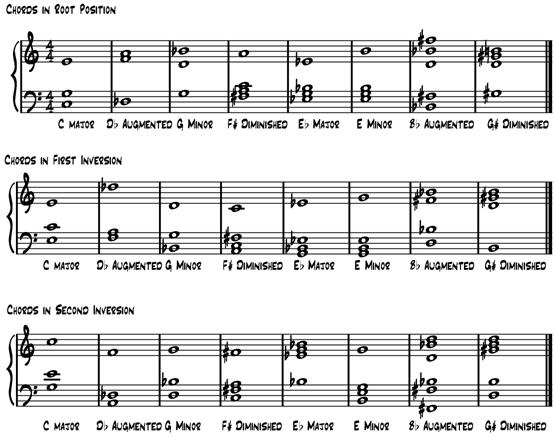
To recap, triads can be arranged in any way you please, with as much space between notes, and as many duplicated notes as you like, as long as they contain the three pitches of the specific triad, they are named accordingly. If the Root is in the bass, the Triad is in Root position, regardless of the arrangement of the upper voices, or higher notes. If the third is in the bass, the triad is in First Inversion. If the the Fifth is in the bass, the triad is in Second Inversion.